Something has to call your URL.
You already built the endpoint. Something has to hit it every five minutes, or Monday at 9, or once, next Thursday — signed so you know it's us, retried when you're down, logged every time, and alerting you when it isn't. Your AI can set it up in a sentence.
$15 a month, and it isn't just this app — every Parsons product is on the same subscription. Cancel any time. 20,000 fires a month included, account-wide. Past that they're priced, not refused — $17 a million from credits you loaded.
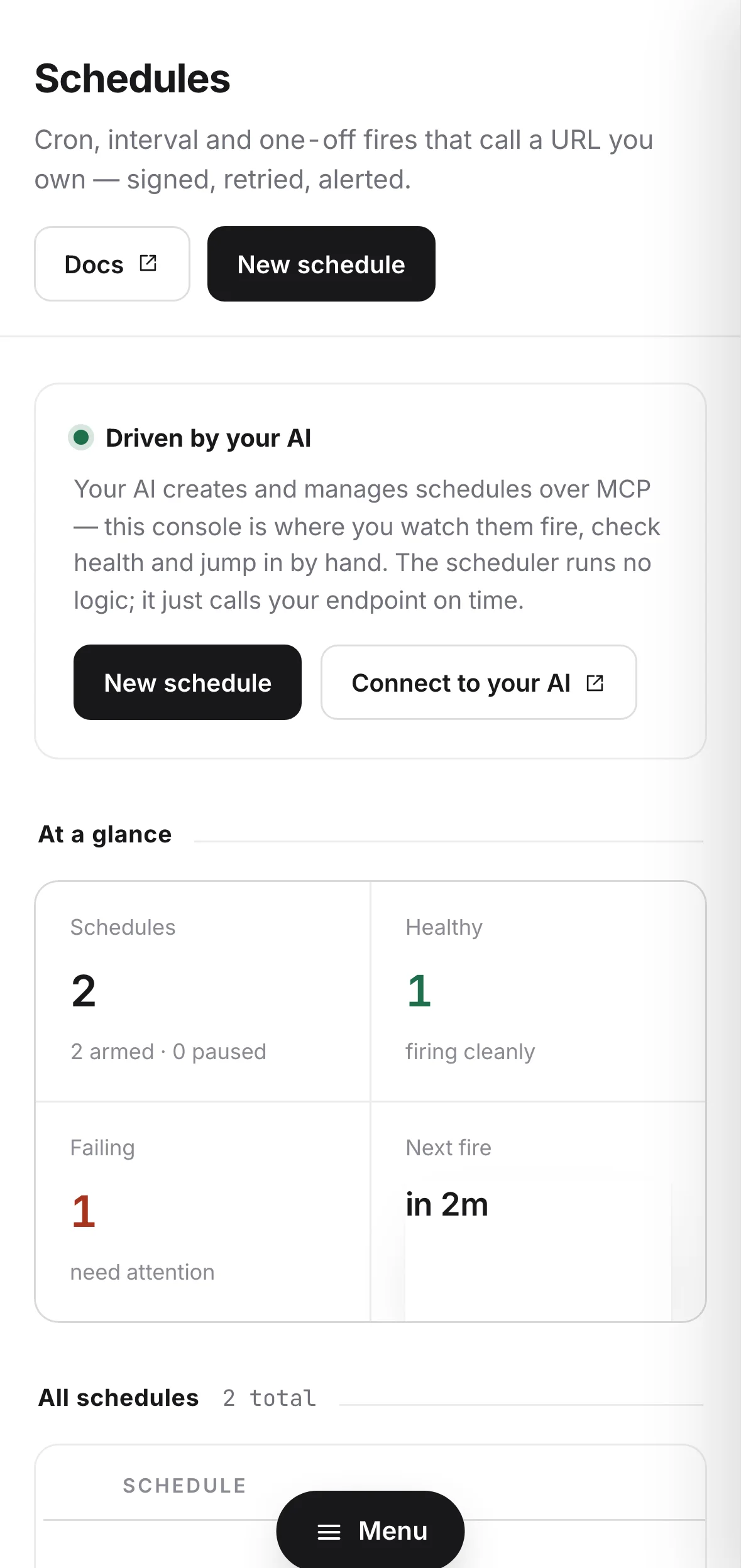
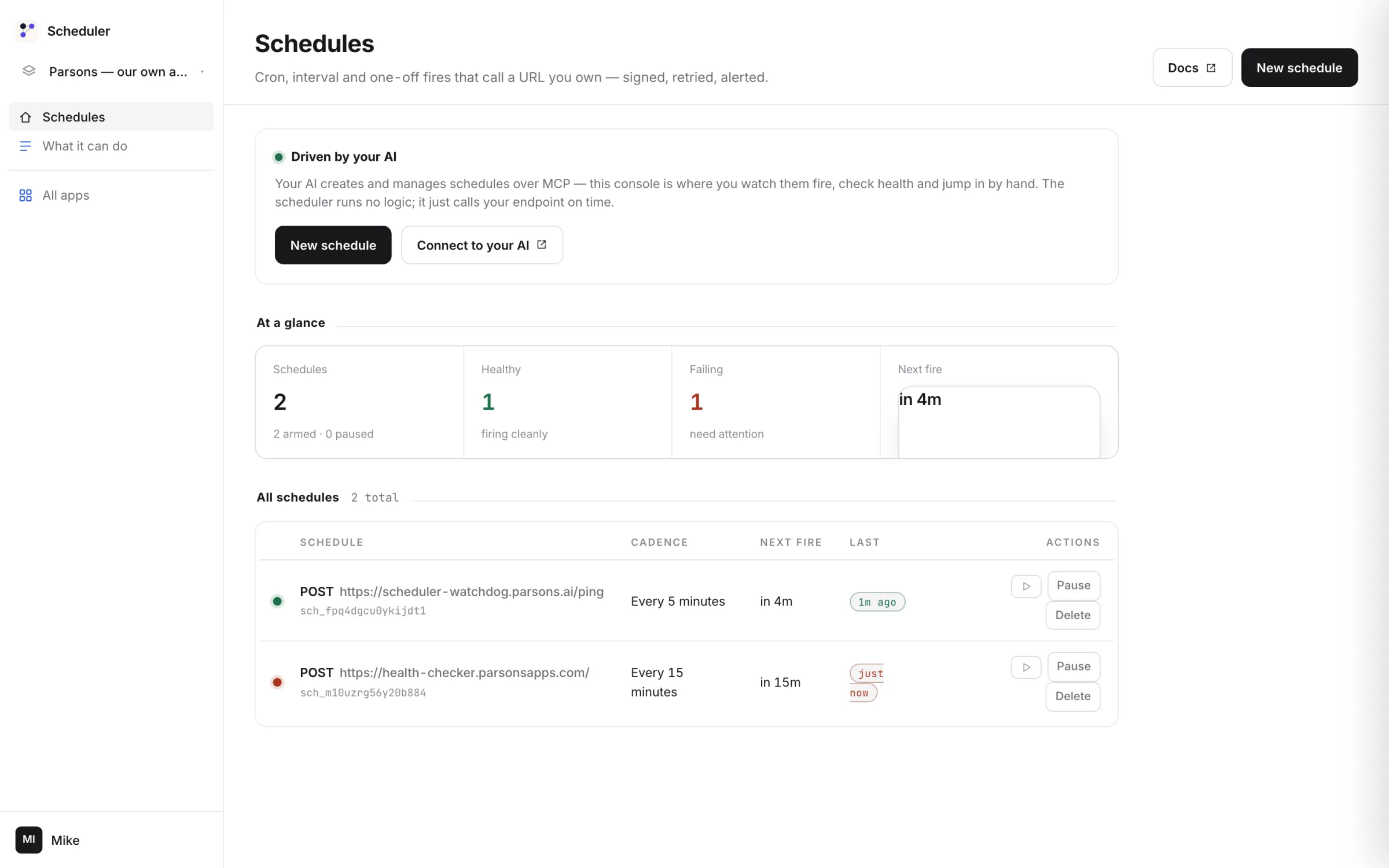
A URL, a cadence, a signature. Then it fires.
Say when.
Cron, an interval, or once at a time. In words or in cron syntax — your AI writes it either way.
Hit the watchdog endpoint every five minutes, and the digest every Monday at 9.Paste one link into your AI.
Your account comes with one private address. Paste it into Claude, ChatGPT or Cursor once, and Scheduler's tools are there. No AI of your own? The console has chat built in.
https://mcp-hub.parsons.ai/p/prof_••••••••/mcpIt calls you, signed.
Every request carries a signature you verify in one line. Your endpoint can refuse anything that isn't from your schedule.
Show me the last five fires of the watchdog.Know when it stops.
Retries with backoff. Alerts when an endpoint keeps failing. A schedule that fails quietly is the one thing this exists to prevent.
Alert me if the digest fails twice in a row.A clock for the endpoint you already built.
Cron, interval, or once
Three shapes. All in the calendar's time zone, all with a next-fire you can read.
POST/watchdog · X-Parsons-Signature200verifyone line in your handlerokSigned requests
HMAC on every fire, a secret per schedule. Your endpoint trusts the schedule, not the internet.
Retries with backoff
A failing fire is retried, spaced out, and logged as one fire with its attempts. You see both.
An allowance you can do the math on
Every five minutes is 8,640 fires a month — 43% of the allowance. Two of those fit. Past it: priced, not refused.
Changed in a sentence
Reschedule, pause, resume, delete — from chat or the console. The cron string is written for you.
Alerts that reach you
Consecutive failures become a message, on the channels you keep. Silence is the failure mode this exists to end.
It calls your URL on time. It cannot call anyone else's.
- ×Fire a schedule without a signatureEvery request is signed with the schedule's secret. Unsigned fires don't exist.
- ×Hit a URL you didn't registerA schedule targets one URL you own. Changing it is an edit you can read in the log.
- ×Refuse a fire past the allowancePast 20,000, fires are priced from prepaid credits — nothing stops halfway through a month.
- ✓Create, pause, reschedule and delete schedules
- ✓Read every fire, every retry, every failure
- ✓Alert on failures through Notifications
There is no security slogan on this page and no badge we haven't earned. Everything in that list is a thing you can check; the full mechanism and every tool are on the details page.
Fifteen dollars a month — and it isn't just this app.
Is it worth it? Start where we look worst.
A cron box is free on every host, and if you have one you can find, use it. Here's what the hosted cron services publish.
Ours is $15 because it's the scheduler and the endpoint host and the notification layer and the database on one bill. If you only need a cron, EasyCron is four dollars and honest. And there is no free tier because a free cron that stops firing silently is worse than none.